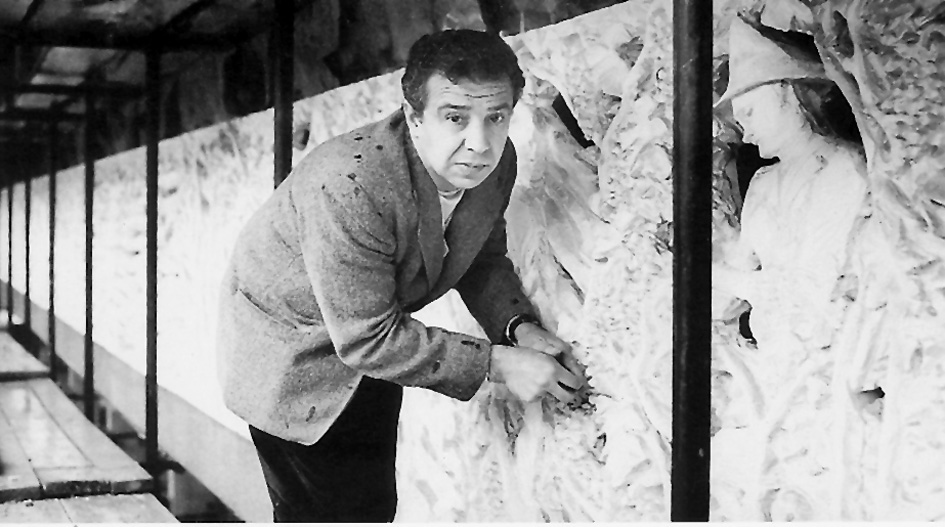
‘I come from a long line of craftsmen. By the age of ten, I was already helping my father carve furniture and had started drawing and modelling puppets.’
With these words, the renowned sculptor Pericle Fazzini recalls his childhood spent in Grottammare, where he was born on 4 May 1913.
At the age of sixteen, he moved to Rome: this marked the beginning of the artist’s successful career, characterised by a prolific exhibition programme across the world’s most important museums.
In his later years, before his death in 1987, the sculptor would often return to Grottammare, the place of his roots, a place where he found a deep joy in life, living freely and in touch with nature.
The Fazzini trail offers an insight into the artist’s prolific career through a number of significant works, such as the sculptures *Boy with Seagulls*, *Metamorphosis*, *Portrait of Mario Rivosecchi* and the *Via Crucis* (inside the church of Sant’Agostino), which are situated along an imaginary route winding its way between the beach and the old town centre.
It is also possible to admire a collection of Fazzini’s works in the exhibition rooms of the Torrione della Battaglia (a defensive bastion of Grottammare’s ancient city walls, dating from the 16th century), including the bronze model for *The Resurrection*, the sculptor’s magnificent artistic legacy which adorns the Sala Nervi in the Vatican.
Torrione Museum
The exhibition rooms of the Torrione della Battaglia house bronze sketches, drawings, lithographs, sketchbooks and other precious objects donated by Pericle Fazzini to his model, Lisa Schneider: a collection of 250 works, acquired by the Fondazione Cassa di Risparmio di Ascoli Piceno, which document the complex creative process and multifaceted inspiration of the ‘sculptor of the wind’.