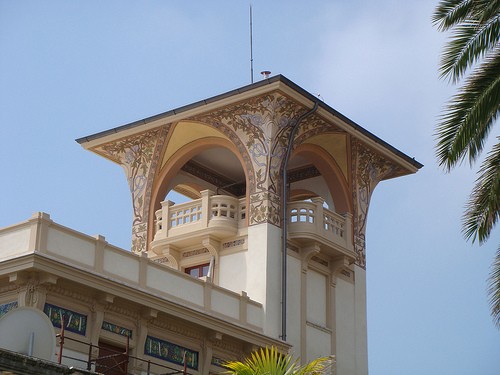
A renowned seaside resort, it was a holiday destination for wealthy families who had ‘second homes’ built here, often commissioning well-known architects with experience in the cities, who brought to the coast the characteristics and influences typical of Art Nouveau, albeit somewhat later than in the major centres where this style had taken hold.
Art Nouveau in Grottammare is characterised above all by its simple yet highly expressive forms and by certain typical and recurring motifs, such as, for example, the ‘altane’ (roof terraces), a style derived from mountain architecture (Alpine chalets with steeply pitched roofs), frescoes and majolica tiles featuring floral decorations.
The largest cluster of these small villas is situated on Viale Colombo, formerly Viale Marino, which was built in 1890. Recently renovated and refurbished, the avenue features paving in porphyry and white Carrara marble, enlivened and embellished with designs drawn from the decorative traditions of the 1920s, and leads into the new Piazza Kursaal, the heart of the Marina, paved in travertine and adorned with a ground-level fountain, a pine grove and palm trees overlooking the beach. The seafront is dotted along its entire length with lush Phoenix canariensis palm trees, which were planted in the early decades of the 20th century.
As well as along the coast, there are also fine examples of Art Nouveau architecture and decoration within the town itself. The finest example of Art Nouveau architecture in Grottammare is the Villino Matricardi-Cola, designed in 1913 by the architect Cesare Bazzani.