The opening of the Adriatic railway in 1863 was one of the key factors in Grottammare’s transformation into a renowned holiday resort during the Belle Époque. In 1873, the first seaside resort was built on the site that would later become Palazzo Kursaal in 1890, the first ‘promenade’, Viale Marino (now Viale Colombo), was built, lined to this day with charming little villas; in 1909, a new town plan allocated small building plots along the coast, thereby influencing the architectural style of the buildings, which began to develop in height rather than in width.
It is against this backdrop that the summer residence of the Ascoli-born entrepreneur Giuseppe Maria Matricardi stands, built in 1913 to a design by one of the most talented architects of the time, the Roman Cesare Bazzani (1873–1939). With his characteristic eclecticism, Bazzani eschewed the grandiloquent style previously employed in public and private buildings (such as the National Library in Florence, the National Gallery of Modern Art and the Palazzina Ravà in Rome, the Cassa di Risparmio building in Ascoli Piceno) and designed a small building of spectacular lightness, the result of a fruitful dialogue with the tastes and business of the client, the owner of a majolica factory, who provided him with products and staff from his company, which in those years also included Adolfo De Carolis, one of the leading figures of the ‘Liberty Style’.
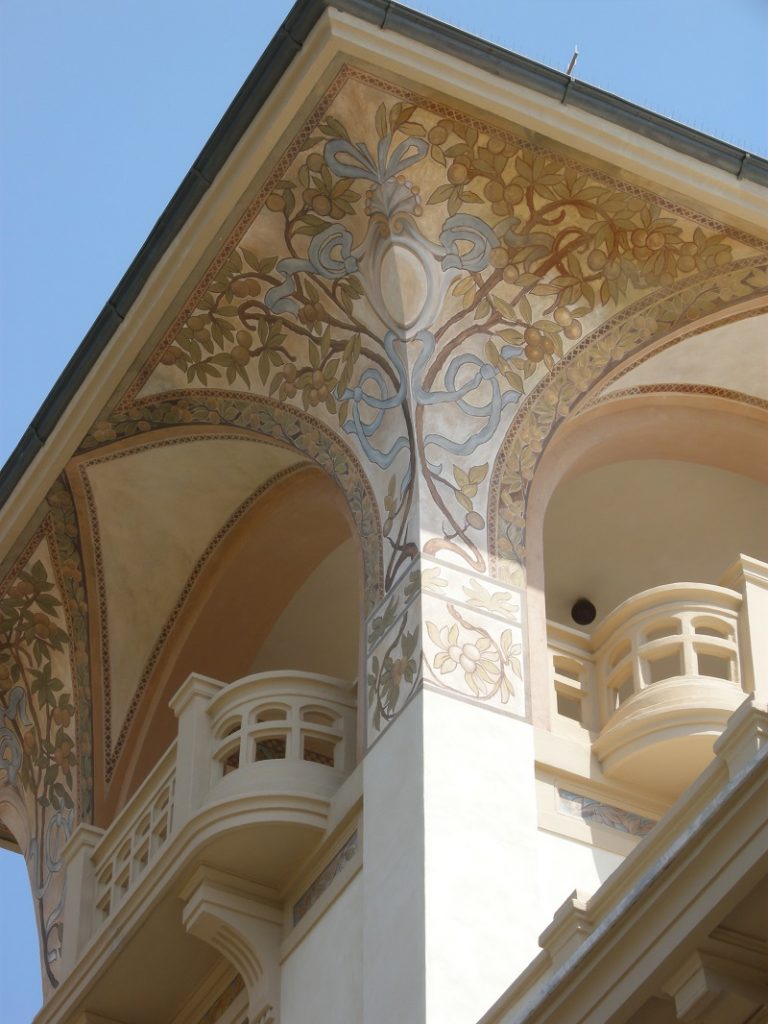
Whilst the east façade of the villa is designed to maximise the sea view, with large windows and a grand door flanked by two glass panes set within a low arch, the west façade is characterised by a roof terrace painted with a dense interweaving of oranges and floral motifs, which create the illusion of a pergola. On its plinth, the inscription ‘GMM/XX-VIII/MCMXIII’ indicates the owner (Giuseppe Maria Matricardi) and the date of completion of the building (20 August 1913). All four sides feature a cornice resting on projecting corbels, beneath which are majolica panels painted with floral and plant garlands, possibly based on a design by De Carolis.
The interior of the villa is decorated, on the ground floor, with wall paintings featuring floral and animal motifs. The garden, which opens out onto the beach—from which it is separated by a simple railing—has an asymmetrical layout that gives it a seemingly disordered appearance, somewhat like certain Pre-Raphaelite paintings, although the vegetation (pine trees, holm oaks, pittosporum hedges, laurel, oleanders and palm trees) is typical of the Mediterranean scrub.