

The present-day building is the result of the extension of a small villa built around 1786 by Bartolomeo Bacher, Bishop of Ripatransone, a keen agronomist who expanded orange cultivation in Grottammare. The extension was carried out by the Marquises of Laureati, an ancient family from the Marche region who purchased the property from the elderly bishop in 1807 and remain its owners to this day.
Like, and even more so than, the other historic buildings overlooking what was once the Via Lauretana – now the busy Strada Statale Adriatica – the villa today has a different character from its original one, as it has been surrounded by more recent buildings that have altered the setting in which it was originally built. Nevertheless, and despite the nineteenth-century extension mentioned earlier, the influence of the first owner has by no means faded: the marked simplicity of Palazzo Laureati’s architectural structure stems from Bacher’s austere taste – the same simplicity found, for example, in another building commissioned in Grottammare by the bishop-agronomist, the Church of St John the Baptist.
Spanning three storeys, the building’s main body is flanked by two wings that were once used as stables; these enclose a garden with palm trees and citrus trees, onto which spacious terraces open.
The façade is clad in brick and framed by travertine corner rustication; the string courses, window reveals and pilasters – all made of the same material – divide the façade into three sections. The villa is crowned by a square roof terrace with two windows on each side, which echo the decorative motifs of the main body of the building.
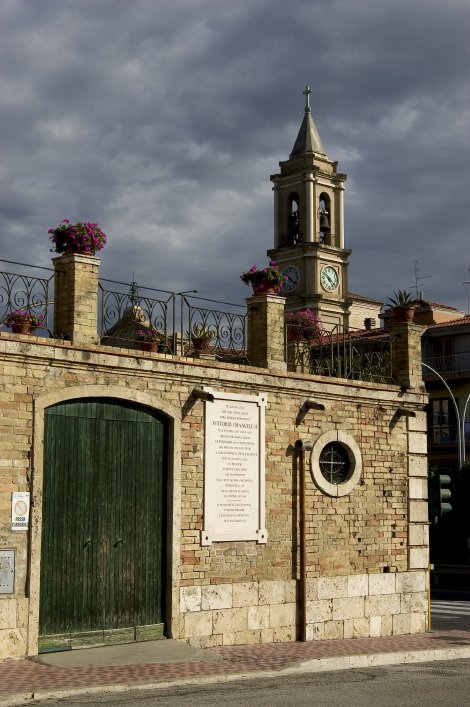
In 1860, Marquis Marino Laureati hosted Vittorio Emanuele II – who was soon to become the first King of Italy – at the villa; the king received the Neapolitan delegation, which had come to urge the annexation of Naples, in the reception hall. A plaque erected in 1882 on the southern side of the villa commemorates this event, which was also celebrated 50 years later by the Monument commemorating the annexation of Naples, situated in the Ricciotti Pine Forest. As if to bring things full circle, in 1925 the palace also hosted the man who would become Italy’s last sovereign, the ‘King of May’ Umberto II, then Prince of Naples.