

History
The area is also of considerable archaeological interest, as evidenced by a number of finds.
Father Nicola was able to take possession of the little church and the surrounding land on 14 July 1614. He was entrusted with overseeing the building work, and part of the monastery was immediately constructed; the monks settled there and began to celebrate Mass in the existing little church. Once the monastery was completed, the new church was built, ensuring that the image of the Virgin Mary painted on the wall of the ancient sanctuary could be preserved.
Today, all that remains of this votive fresco is a fragment depicting the Madonna and Child, situated in the apse above the wooden choir, which is the part that was saved from a fire that destroyed most of the painting.
The entire complex, including the vegetable gardens, the lawn and the large garden, was enclosed by a wall.
In the nineteenth century, the complex experienced a series of ups and downs following the Napoleonic conquest, the Restoration and the unification of Italy.
Following the Napoleonic suppressions, the church was incorporated into the parish and the convent was put up for auction and purchased by Giambattista Giammarini. With the Restoration, the complex was returned to the friars, who returned there in 1816.
Following the unification of Italy, the Rattazzi Law of 1855 was extended by the Piedmontese state to the whole of Italy; this law decreed the abolition of religious orders, affecting in particular the Augustinian and Franciscan monasteries.
In 1864, following the enactment of this law, the monastery was dissolved, the friars left the convent and its assets were transferred to the municipality of Grottammare. Among the convent’s possessions was an organ built by the organ-builder Gaetano Callido in 1784 for this church.
Following its removal, the organ was transferred in 1864 to the Church of St Pius V in Grottammare, where it can still be seen today.
In 1879, the convent became the site of the Peretti boarding school, which remained open until 1918.
In 1935, the friars asked the municipality of Grottammare for permission to return to the convent, which was sold to them, together with its outbuildings, for £35,000. On this occasion, the complex was refurbished.
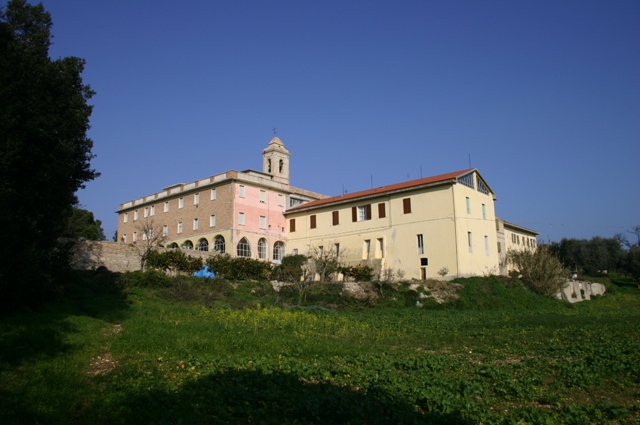
Since the early 1950s, the complex has been known as the Oasi di Santa Maria ai Monti dei Frati Minori Riformati and has become a venue for meetings and stays for associations, priests, nuns and members of the public, as well as a place where the feast of Saint Aurelian the Martyr is celebrated. The complex comprises two buildings, dating from the last century, situated to the west and north of the church.
Description
The main façade of the complex features two lower wings flanking the church. The church façade is built in a simple style, with exposed brickwork, and is topped by a triangular pediment supported by four pilasters, which frame the entrance portal adorned with an architectural cornice topped by a curved pediment and surmounted by a rectangular opening.
The convent building comprises a recently constructed section, to the west and north of the church, and an original wing to the east. The ancient structure is laid out around a courtyard enclosed on the northern side by the present-day boundary wall. The courtyard is square, with a central well, and features porticoes with cross-vaulted and barrel-vaulted ceilings; it is bordered by two-storey façades.
The interior of the church is adorned with various works of art. To the right as you enter is a painting depicting Saint James of the Marches of Monteprandone, Saint Bonaventure of Bagnoregio, Saint Diego and Saint Anthony the Abbot.
According to a different interpretation, the saints depicted are not Saint Diego and Saint Anthony the Abbot, but Saint Pacificus of San Severino and Saint Benedict Scativoli (Bishop of Osimo). The painting must date from a year after 1780.
Immediately behind the altar, visitors can admire the Madonna della Pace, a wooden sculpture by Francesco Santori, above which hangs a painting of considerable value depicting St Francis, once attributed to the famous painter Guercino da Cento (1591–1666), but now attributed to a painter from his school.
Near the apse stands the altar, with an altarpiece depicting the Virgin and Child, Saint Nicholas of Tolentino and the souls in Purgatory. In the apse, above the wooden choir, one can see the ancient fresco of the Virgin and Child (16th century).
Continuing along the perimeter of the church, we come to the altarpiece depicting the Madonna and Child with Saint Anne and Saints Francis, Elizabeth and Louis IX. Just beyond the altar, high up on the wall, is a work depicting a Pietà. The altar immediately to the left of the entrance features a crucifix.
The church also houses the tomb of Blessed Lavinia Sernardi, who was born in Grottammare on 2 June 1588 and whose spiritual director was Father Nicola.
Following a series of restoration works, the church has undergone a radical transformation, and the ancient oratory, the inscriptions on the walls and the paintings by Friar Lorenzo Bonomi – who had frescoed the cloister with scenes from the life of St Francis in the 17th century – have all disappeared. The Stations of the Cross, the work of Ubaldo Ferretti, have been installed in the complex.
In 1750, the friars planted a dense holm oak woodland intended to provide respite from the summer heat and a place for meditation. To this day, this woodland remains within the grounds of the monastery.