

The new settlement of Grottammare
In the second half of the 18th century, due to repeated landslides affecting the old town centre of Grottammare and the need arising from a rise in population, it was decided to develop a new building area towards the coast.
The landslide of 25 January 1779 prompted the decision and, by means of a papal chirograph issued in November of that same year, Pope Pius VI set about drawing up the town-planning scheme for the new settlement.
The project was entrusted to the architect Pietro Augustoni (Como 1741–Fermo 1815). The new town plan was inspired by the neoclassical principles of equality and symmetry, which were very widespread at the time in both architecture and town planning.
In fact, the new buildings were to be arranged in rectangular blocks defined by three axes running parallel to Via Lauretana (now the Strada Statale), the main thoroughfare of the new settlement, running north to south, and by streets intersecting these at right angles.
Lungo la via principale gli edifici dovevano avere tre piani, mentre nelle aree retrostanti due piani. Three functional areas of the city were also identified, in accordance with an urban planning concept based on the Hippodamian model: the residential area, which also housed public buildings, along the Via Lauretana; the area set aside for industrial and commercial activities close to the beach; and a ‘working-class’ area around the church of San Pio V.
The new settlement was to be laid out around the central square, opening onto Via Lauretana, which was to house the new church, dedicated to St Pius V.
The stages of the church’s construction
The church was designed by the architect Pietro Augustoni in 1779, alongside the town plan for the new settlement. Construction of the building began in 1780 and initially followed the original design, which can be seen in the central nave and the apse.
Construction took a long time: between 1847 and 1850, the church was extended, and it was during this phase of construction that the central nave was completed and the new façade, designed by the architect Virginio Vespignani (Rome, 1808–1882), was built.
Construction of the bell tower began in 1929 and was completed in 1955, based on a design by the architect Emilio Ciucci.
Description
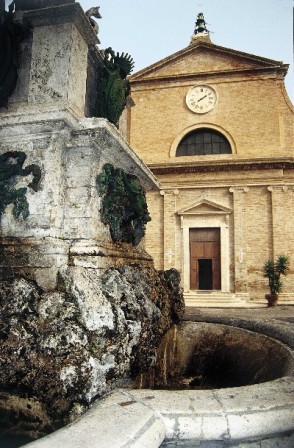
The church’s façade, built of exposed brick, is divided into two sections, emphasised by a projecting cornice decorated with dentils.
The upper section features a semi-circular rose window surmounted by a clock and is topped by a triangular pediment.
The lower section is punctuated by four Ionic pilasters that mimic the classical portico and, in the centre, the doorway, whose architectural frame echoes the motif of the triangular pediment.
The design of the façade is inspired by Roman churches, in particular those by Jacopo Barozzi, known as Vignola (1507–1573).
The portal was designed by the sculptor Aldo Sergiacomi (Offida, 1912–1994) but was only completed after his death by his collaborator, Fausta Derna Perozzi, and donated to the church by Diego Scartozzi.
The door panels depict the Holy Jubilee and the accession of Sixtus V to the papal throne. They also feature Saint Francis of Assisi, the patron saint of Grottammare San Paterniano, Saint Teresa and Saint Umberto, in memory of the patron’s parents.
The interior is very spacious and light, and has a Latin cross plan, with a central nave ending in an apse and two side aisles, separated from the central nave by round arches.
The dome is situated at the junction of the nave and the transept, with an eight-sided umbrella-shaped roof resting on an octagonal drum. The church contains many interesting works of art.
The altarpiece of the high altar depicts Saint Pius V in prayer before the Virgin Mary; it was painted by Luigi Falconi, an artist from Recanati: the work shows the holy pontiff giving thanks to the Virgin Mary for the victory of the Christian fleet over the Turkish fleet on 7 October 1571 in the waters off Lepanto.
To emphasise this historic event, the painting depicts two Turkish slaves bound to the tall plinth, on which a scene from the battle is depicted. Beneath the altarpiece stands the wooden choir, and, also in the apse area, the three-seater wooden bench crafted by Vittorio Fazzini, father of the more famous Pericle.
Other notable paintings include the canvas depicting the Virgin Mary, Saint Dominic and Saint Catherine by Luigi Fontana (1827–1908) and the one depicting Saint Philip Neri by Felici.
The church also houses a fine architectural baptistery, crowned by a wooden statue of St John the Baptist. The walls of the main nave feature Cleto Capponi’s ceramic Stations of the Cross and the ambo by the sculptor Ubaldo Ferretti.
The church also houses a fine organ built in 1784 by the organ-builder Gaetano Callido for the Church of Santa Maria ai Monti and moved to the Church of San Pio V in 1864, following the suppression of religious orders in the wake of the unification of Italy.
The fountain
The square in front is adorned with a fountain designed by the architect Murri in 1875. It has a circular plan, stands on a stepped travertine plinth and features two basins.
The main basin is made of brick, and rising from it is a vertical element adorned with decorations, featuring lion protomes and the coat of arms of Grottammare; the second basin is made of stone, is smaller in size and crowns the fountain at the top.
Sisto V
In 1984, the sculptor Aldo Sergiacomi erected a bronze statue of Pope Sixtus V in the square, a further tribute paid to the Pope by his hometown.
The statue of Pope Sixtus V, in front of the church of St Pius V, is also justified by the ties that bound the two popes: indeed, Sixtus V was appointed cardinal by Pope Pius V and served as his personal confessor.