

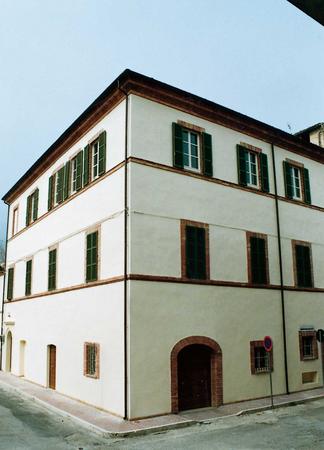
Nicola Fenili (1765–1829) moved from Rome to Grottammare following his appointment as administrative inspector of the local department of the Papal States. On the inspector’s own initiative, and later thanks to his son Carlo (1799–1874), the Fenili family became owners of some of the many factories that flourished in Grottammare during the 19th century (silk, sugar, matches), which were heavily geared towards export to such an extent that, at that time, the town was home to several foreign consular offices.
The family mansion is situated in what was once the most central part of Grottammare’s ‘new town’, which began to develop in 1779 in accordance with Pietro Augustoni’s town-planning scheme, facing Via Lauretana (now the Statale Adriatica) and near the Church of San Pio V. Although unassuming in appearance from the outside, this late 18th-century residence reveals its stately character within. A grand staircase in the style of Vanvitelli provides access to the main floor, whose rooms feature ceilings decorated with floral and plant motifs, grotesques, medallions imitating ancient bas-reliefs and slender fantastical figures, in keeping with the Neo-Pompeian style then in vogue.
The unknown artist behind these decorations (based on stylistic analysis, the name Felice Giani has been put forward) further demonstrated his commitment to the latest trends by assigning a dominant colour to each room in the palace: yellow for the music room (Sala Gialla), blue for the master bedroom (Sala Azzurra), green for the study (Sala Verde), whilst the library (Stanza delle Arti) features a ceiling decorated with four roundels depicting music, war, painting and literature, alternating with representations of the four seasons.
In another room on the second floor, Franz Liszt stayed during the summer of 1868, and he retained the fondest memories of this experience. It is the Hungarian composer himself who reminds us that the building had a small garden at the rear, “not particularly luxurious, but with many orange trees, fig trees and vines”. A few years earlier, the same building had housed the general staff of the Savoy army accompanying King Victor Emmanuel II, who had come to Grottammare to meet the Neapolitan delegation in favour of annexation to the Kingdom of Italy (October 1860).
Having passed into state ownership following the extinction of the Fenili family, the building now houses the police commissioner’s flat, whilst an adjoining wing – formerly home to a manufacturing workshop – is now occupied by the local Carabinieri station.