

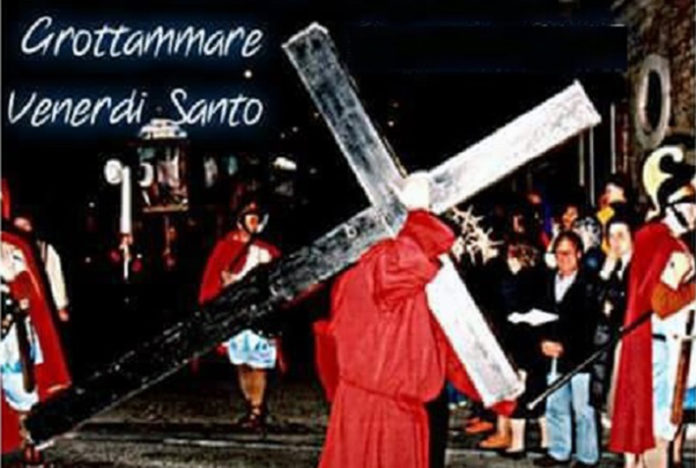
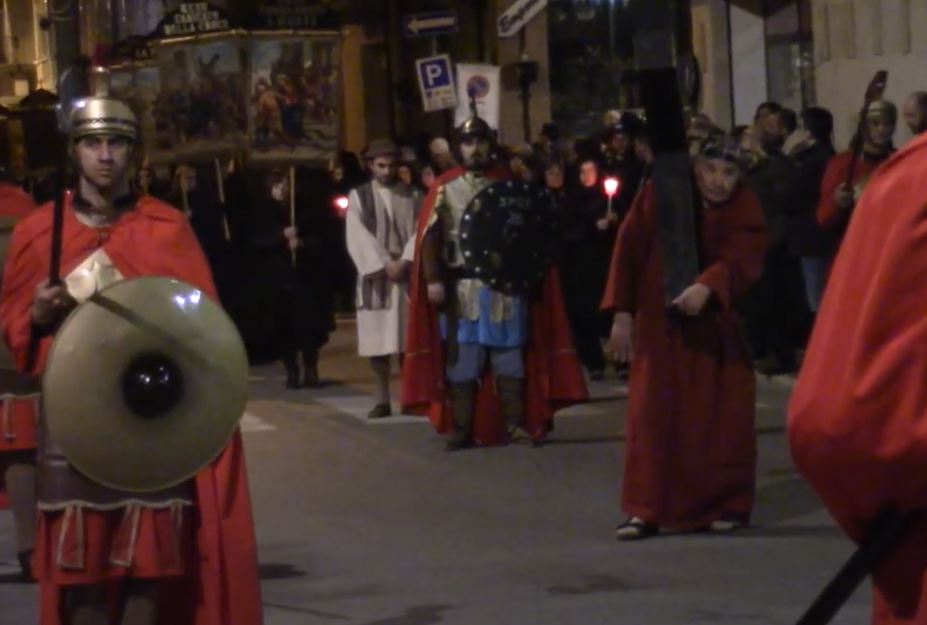
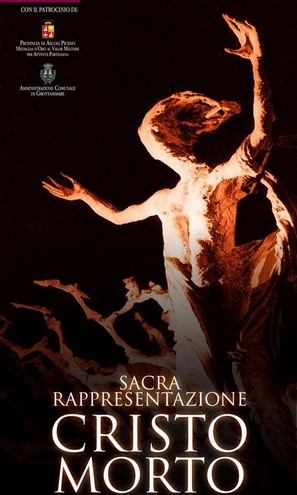
The Sacred Re-enactment of the Death of Christ is a deeply religious tradition, steeped in emotion, which takes place every three years on Good Friday evening. The tradition dates back to the 18th century and consists of a symbolic, live re-enactment of the Passion and death of Christ. The Sacred Re-enactment in Grottammare differs from other Holy Week processions both in its cyclical nature and in the way it is conducted. It is neither a historical procession nor a Way of the Cross; rather, it is a moving narrative of a religious event that winds its way through the entire town in the strictest silence.
The Good Friday evening re-enactment is one of the oldest in the area – second only to the procession of the Dead Christ in Ripatransone, established in 1624 – and was founded on 4 April 1738 by Father Antonio Petrocchi da Castignano with the approval of Monsignor Francesco Andrea Correa, Bishop of Ripatransone. In the past, it took place annually, although we do not know exactly how – the new town of Grottammare, in fact, was not built until 1790, so it is difficult to imagine that, from the time of its foundation, the procession ever ventured outside the walls of the old town –
The procession was attended by the brotherhoods of Grottammare that were active at the time:
- The Confraternity of the Most Holy Sacrament, the oldest confraternity in Grottammare and guardian of tradition, established in the parish church of St John the Baptist in the 16th century (parish archives indicate that the confraternity was already active during Bishop Sasso’s pastoral visit in 1573), has been responsible for organising the religious festival of the Sacra Giubilare since the mid-1500s.
- The Confraternity of the Rosary was established in the parish church of St John the Baptist in the 16th century. The confraternity remained active until 1805, when, due to restrictions imposed by the Napoleonic Kingdom of Italy, it was forced to disband, only to be re-established in 1819 thanks to the efforts of Bishop Ignazio Ranaldi.
From 1757, responsibility for organising and conducting the procession passed to the newly established Confraternity of the Passion and Death of Our Lord Jesus Christ and of His Most Glorious and Sorrowful Mother – the present-day Confraternity of Our Lady of Sorrows – established by Bishop Luca Nicolò Recco on 10 February of that same year and immediately united with the ancient Confraternity of the Most Holy Sacrament by a papal bull issued by the same bishop. By joining the city’s oldest confraternity, the new Company inherited its role as ‘guardian’ of the most ancient traditions.
Since 1805, the new Confraternity of the Heart of Jesus (known as the ‘Sacconi’) – established at the Church of St Augustine on 21 October 1805 – has also been involved in organising the procession.
Even today, it is possible to identify within the procession the roles that historically belonged to the old brotherhoods, thanks to the different robes and cloaks worn by the members.
It was probably during these years that the procession began to make its way down towards ‘la marina’, becoming ever richer in both participants and significance.
In 1930, Bishop Luigi Ferri laid down the “instructions for the procession of over 500 people, followed by thousands of the faithful marching in a predetermined order”.
What we see parading today, therefore, is a Sacred Procession that has been organised since 1738 but which follows the protocol established in 1930.
What makes this performance unique is its deep connection with the town. Indeed, the characters in the performance have always been residents of Grottammare who, out of love and loyalty to the memory of the past, keep this historic tradition alive, passing down the roles they play in the procession from generation to generation within their families. Each person is called upon to take on, for one night, a role that belonged to one of their ancestors many years ago.
Route
Piazza Peretti – Via San Giovanni Battista – Via Palmaroli – Via Sant’Agostino – Piazza Garibaldi – Via Leopardi – Via XX Settembre – Viale Ballestra – Via Marconi – Via Leopardi – Via Matteotti – Via Laureati, Via F.lli Cairoli – Viale Sisto V – Viale Crucioli – Corso Mazzini – Piazza Garibaldi – Via Sant’Agostino – Church of Sant’Agostino.
Upcoming editions of the Sacred Re-enactment
7 April 2023
3 April 2026
30 March 2029
26 March 2032
23 March 2035
23 April 2038
19 April 2041
15 aprile 2044
12 April 2047
8 April 2050