

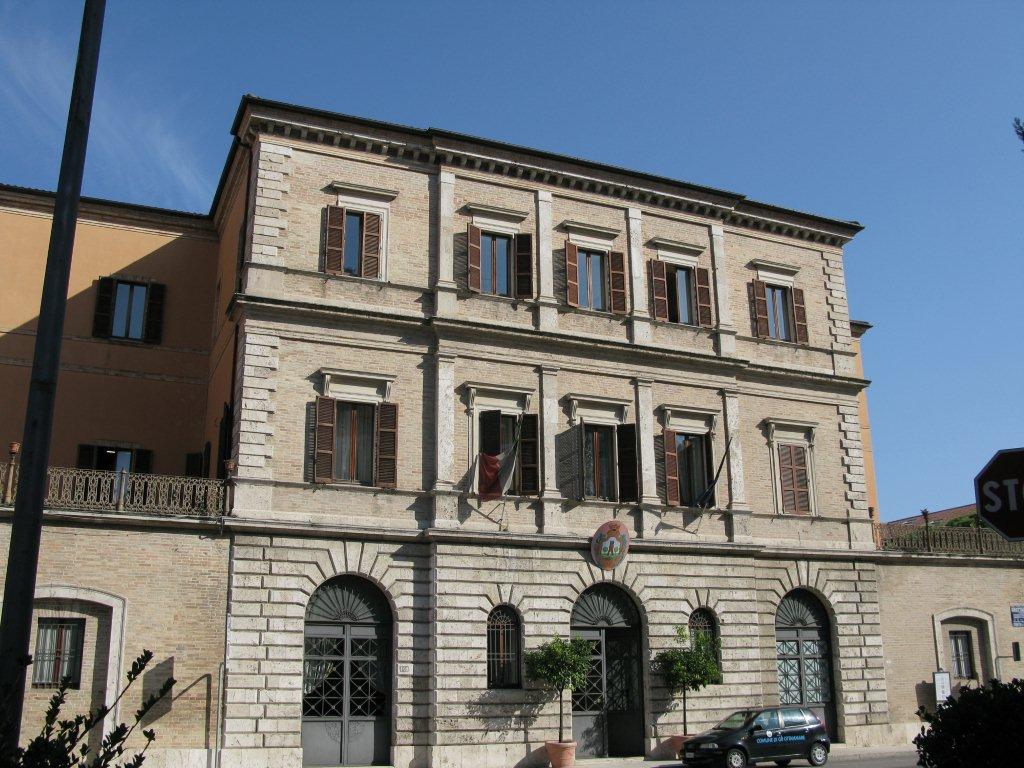
The Ravenna family moved to Grottammare in the early 18th century, probably from Savoy. Their business acumen, demonstrated over time in various fields of enterprise, enabled them to contribute significantly to the remarkable economic development that Grottammare experienced between the 18th and 19th centuries. As it had by then become clear that local urban expansion would centre on the coastal strip, the family had a residence built along the main thoroughfare of what came to be known as the ‘new town’, planned by the architect Pietro Augustoni on behalf of Pope Pius VI from 1779 onwards.
There were two main reasons for the development of the coastal area: a population increase that the hilly area was now struggling to accommodate and, above all, the effects of a devastating landslide that struck the old village in January 1779. Augustoni drew up the urban plan in accordance with neoclassical concepts, that is, based on the principles of regularity, functionality and symmetry. Among other things, he devised a network of roads running parallel and perpendicular to the coastline, distinguished between residential, industrial and working-class areas, and stipulated that buildings should be of uniform height depending on their location within the town plan.
The building features a simple main façade overlooking Via Lauretana, rising in three storeys marked by string courses. From the central section, which projects slightly, two brick wings extend, each the same height as the first floor, topped by a terrace. The eastern façade (the part of the building facing the sea) is set back from the road and features a large garden with tall palm trees, currently used as a venue for various summer events. The entrance portal on this side, raised above garden level and accessible via a short flight of steps, now serves as the main entrance to Grottammare Town Hall.
In addition to the Council Chamber and a number of administrative offices, the building also houses the Reception Hall, notable above all for the frescoes decorating its ceiling, possibly painted by Pio Panfili (1723–1812), an engraver and painter from the Marche region who was mainly active in Bologna and Fermo. Divided into five panels, the central panel features an oval adorned with trompe-l’oeil coffered panels and an elegant floral motif, whilst the four side panels display, within a decoration of volutes and acanthus leaves, small tondos depicting refined landscape views. Overall, the decorations show little of the illusionistic, Rococo-style flair displayed by Panfili in other contexts, drawing instead on the neoclassical sensibility that characterises both the architectural structure of Palazzo Ravenna and the urban layout of the Augustoni.