

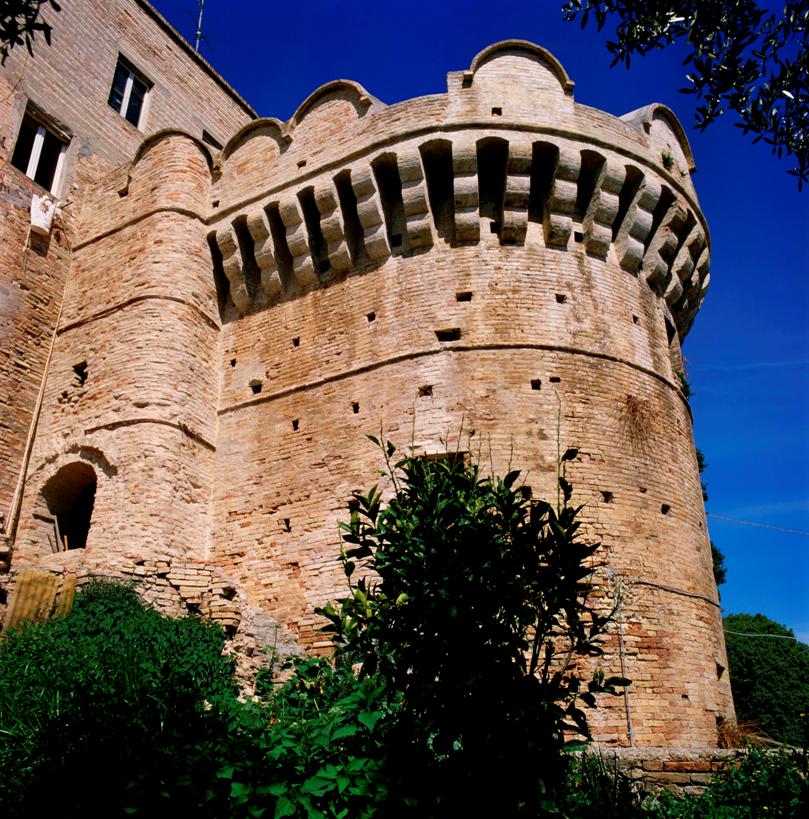
Accounts of the fortifications of the ancient village of Grottammare refer to an initial medieval wall, built in successive phases up to the 15th century to defend the castle and the fortress jutting out over the sea, and a more extensive and imposing series of bastions dating from the mid-16th century, including the Torrione della Battaglia.
The need to overhaul the defensive system was primarily due to pirate raids, a constant threat to all Mediterranean coastal towns until a few centuries ago. There is documentary evidence of pirate attacks on Grottammare dating back to 1479, but the most critical date was 1525, when a crew from Dulcigno (Ulcinj, in present-day Montenegro) managed to make off with a large haul of booty and kidnap several of its inhabitants.
Built from 1540 onwards by Lombard and local craftsmen, the Torrione della Battaglia most likely owes its name to the soldiers stationed there to defend the village, who, in all likelihood, had their quarters and armoury there. As various 16th-century texts (including Niccolò Machiavelli’s *The Prince* and *The Art of War*) show, at the time of its construction the term ‘battaglia’, as well as having the common meaning it still retains today, was synonymous with ‘soldiers’; therefore, the most likely meaning of the name is ‘tower of the soldiers’.
Adjoining the city walls in a strategic position, near the city gate known as the ‘Marina’, overlooking the sea and the ancient harbour, the structure consists of a cylindrical body with a semicircular base, the lower part of which is now a basement. The upper part is crowned by trefoil-shaped barbicans supporting a parapet comprising five battlements, rounded at the top.
Following the restoration carried out at the beginning of the century, the two storeys into which the interior of the building is divided are connected by a brick staircase and a lift, replacing the wooden staircase originally planned. Since 2003, the building has housed the Torrione della Battaglia Museum, which exhibits a collection of works by the sculptor Pericle Fazzini.