

19th-century sundial displaying the ‘hora italica’ (reproduction) – Osteria dell’Arancio
The old town centre of Grottammare features the classic medieval layout, in which the town’s most important buildings are arranged around the main square. This enclosed layout provides a secure defence whilst also fostering a sense of ‘community’ and ‘practicality’, with the square becoming the beating heart of the town. In addition to its architectural and artistic treasures, Piazza Peretti is home to two ‘time-measuring devices’ based on different—yet complementary—principles of operation.
On the east side of the square (Osteria dell’Arancio), high up, you can see an Italic-style sundial, which was restored in 2018 by the Montefiore dell’Aso Clock Museum.
It is not easy to grasp at a glance how this clock works, for the fundamental reason that the modern system of timekeeping – known as the ‘French’ system – was only adopted in the Marche region following the calendar reforms introduced by Pope Pius IX in 1847. Prior to that date, the method of measuring time was based on the so-called ‘Italic’ system, according to which a new day began at sunset. This method of calculating the day is, moreover, found throughout Italian literature right up until the end of the 19th century.
The 24-hour Italic time dial, where zero o’clock corresponds to sunset and the twenty-fourth hour to sunset the following day, changes with the seasons. Indeed, during winter, sunset occurs earlier than in summer, so the calculation of the time depends on the season and the specific location (local time). To convert from Italian time to French time, one must carry out a complex series of calculations as well as have a basic understanding of astronomy.
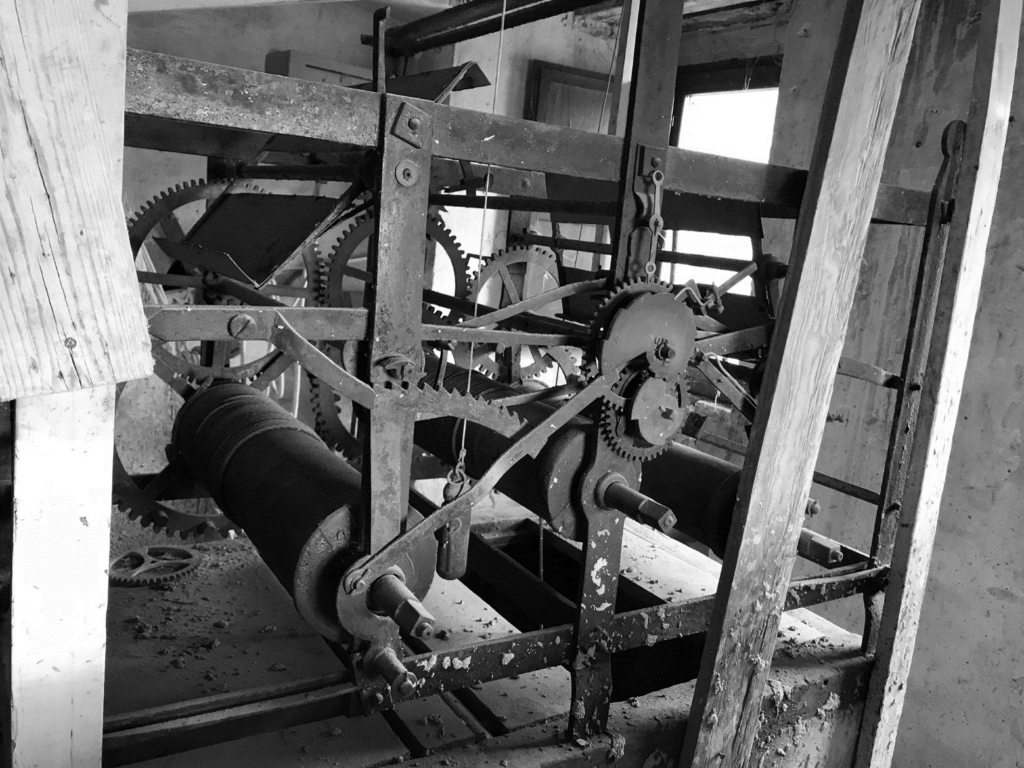
Mechanical pendulum clock by Pietro Mei, 1844 – Teatro dell’Arancio
On the façade of the Teatro dell’Arancio tower, a stone dial with a single hand is clearly visible; before the building was converted into a museum, a mechanical clock was concealed behind it. The mechanical pendulum clock, patented by Christiaan Huygens in 1656, utilises the isochronous motion of the pendulum, discovered by Galileo Galilei before 1592. A pendulum is capable of maintaining its oscillation (time) as long as it is suspended from a weight (load) connected to a system known as the escapement. This is a mechanism that requires constant attention and adjustments carried out by the clock-setter, or ‘moderator’ as they were also known – a role that was actually on the payroll of local councils until the middle of the last century. The moderator was also responsible for synchronising the time using a sundial, usually situated within view of the clock itself, which marked a specific hour, typically local midday.
The mechanical clock in Piazza Peretti was built, as indicated by the maker himself, Pietro Mei (Montecarotto 1797–Montecarotto 1878), on the hour wheel in 1844, bearing the construction number 12. To date, this clock appears to be the second oldest surviving clock by the clockmaker Pietro Mei. The oldest surviving clock by Pietro Mei is number 10, dated 1842, housed at the town hall in Penna San Giovanni (MC). The clock was put on display (December 2022) at the Teatro dell’Arancio, following a process of restoration and conservation carried out by the Montefiore dell’Aso Clock Museum and the restorer Dr Raffaella Marotti of the University of Urbino. The Pietro Mei clock, number 12, is of great importance as it represents a transitional piece between the heavy 18th-century timepieces and Pietro Mei’s more mature clockworks, which were based on very light frames and simplified mechanisms.
Orologio meccanico a pendolo di Antonio Galli – Chiesa San Pio V
The Church of St Pius V forms part of the urban layout established by the town plan drawn up by the architect Pietro Augustoni in 1779. Its construction, which took place in several phases, saw the completion of the façade and the installation of the single-hand clock face following work carried out by the architect Virginio Vespignani (1808–1882) between 1847 and 1850. A bell tower, which the church had previously lacked, was built in 1929. In this instance too, a multi-faced clock mechanism was installed at the top of the bell tower.
The clock on the façade of the Church of St Pius V is the work of Antonio Galli (1822–1893), a clockmaker from the Marche region and a pupil of Pietri Mei of Montecarotto. When Mei died without any sons, Antonio Galli inherited his master’s workshop and continued his work, carrying out various projects in different towns across the Marche region.
Working together, Pietro Mei and Antonio Galli were able to improve and standardise the production of timepieces. Indeed, it was Galli who was responsible for the ever-increasing standardisation of shapes, dimensions and design features aimed at simplifying the mechanics, in order to produce timepieces that were increasingly easy to manage and also affordable for municipalities with limited budgets.
The clock mechanism, which had clearly not been wound for some time (as evidenced by the detached outer hand), was identified in its original location, which had since been converted into a storeroom for sacred furnishings. Now under observation, it is awaiting cleaning and subsequent display in the museum.
Orologio meccanico a pendolo di Edoardo Marconi del 1922 – Palazzo Citeroni
Landslides and the increasingly difficult development of the old town centre of Grottammare highlighted the need to plan and subsequently build houses and infrastructure in the area in front of the old town centre, which overlooks the Adriatic Sea.
The new town plan for Grottammare, drawn up by Pietro Augustoni (1741–1815), laid the foundations for the ‘new town’ (1779).
The Gregorian Land Registry of 1813 already records a building corresponding to the present-day Palazzo Citeroni, on the corner of which stood the civic tower of Grottammare, housing a mechanical clock capable of striking the hours and quarters (as evidenced by the quarter-hour and hour bells installed at the top of the tower). The clock originally had a dial facing the square; later versions featured dials on both sides.
In 1925, Palazzo Citeroni was completely renovated in the neoclassical style. The town tower was not rebuilt, although its specific function as a ‘public clock’ was preserved thanks to the creation of a niche in which a new mechanical clock was installed (the current one; there is no record of the previous one), which is maintained by the local council due to its public function. The municipal attendant would wind the clock via a compartment on the outer wall.
The new mechanical clock in the niche is the work of Edoardo Marconi from the Marche region, the last practitioner of the ‘Montecarottesi’ artisan workshop. Marconi’s clocks feature significant innovations compared to those of the early masters – the Podrini brothers, Pietro Mei and Antonio Galli.