

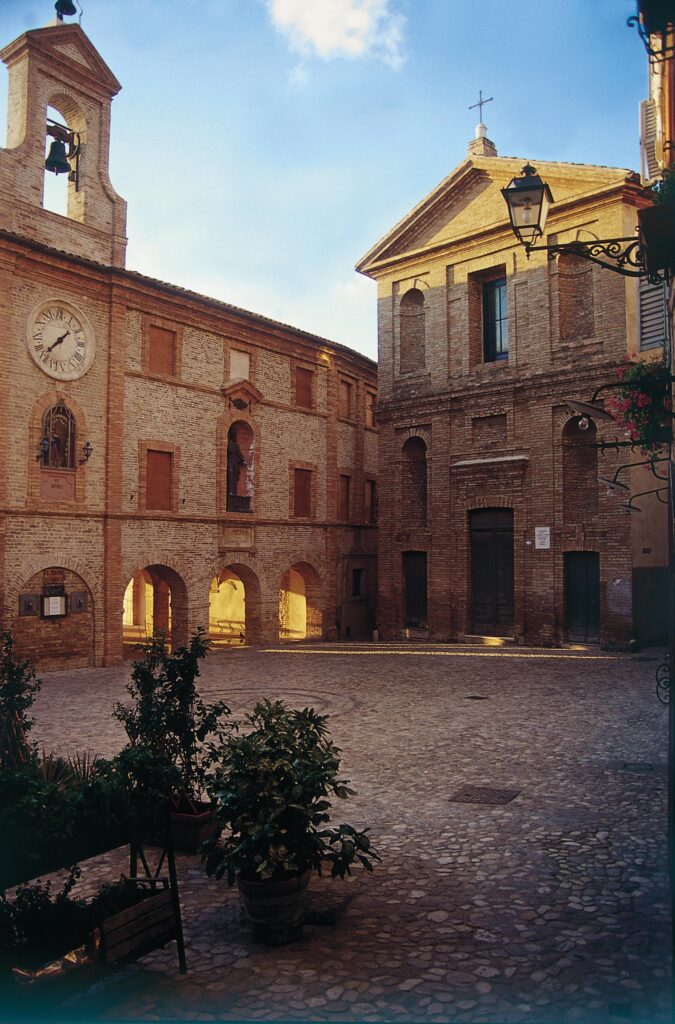
The square is the heart of the old town and exudes a unique atmosphere and charm, both because of its colours – determined by the prevalence of brickwork and cobblestones – and because of its layout. It is named after Felice Peretti, whose papal effigy presides over the façade of the Teatro dell’Arancio in a statue sculpted in 1794 by Stefano Interlenghi.
According to historians, the square dates back to the Middle Ages, but its current appearance dates from the late 18th century and is the work of the architect Pietro Maggi, who was commissioned to design the Teatro dell’Arancio and the church of San Giovanni Battista.
The eastern side of the square is dominated by a building set back from the street, featuring a deep loggia with arches and cross vaults that opens out onto the sea and houses the Teatro dell’Arancio, the civic tower and the old town hall. The civic tower, topped by a bell tower, features a clock donated by Pius IX in 1857 and a niche containing a statue of the Madonna and Child. The façade of the building is completed by the old town hall, which served this purpose until the mid-19th century: the Napoleonic land register, dated 1822, states that the building housed ‘the council chamber, the municipal archives, the public bakery, the Monte Pecuniario Peretti, two shops, two rooms used as a café with a billiard table, the government prison (…), and the military prison’ . The Church of St John the Baptist, the old convent and historic palaces also overlook the square.
These buildings, with their loggias, doors and the streets that wind their way between the houses, define the structure and the variety of perspectives of the square, both delimiting and expanding its space as in a scene from classical theatre.
Piazza Peretti is home to the Church of St John the Baptist, which houses the Sistine Museum, the Teatro dell’Arancio and the Il Tarpato Museum