

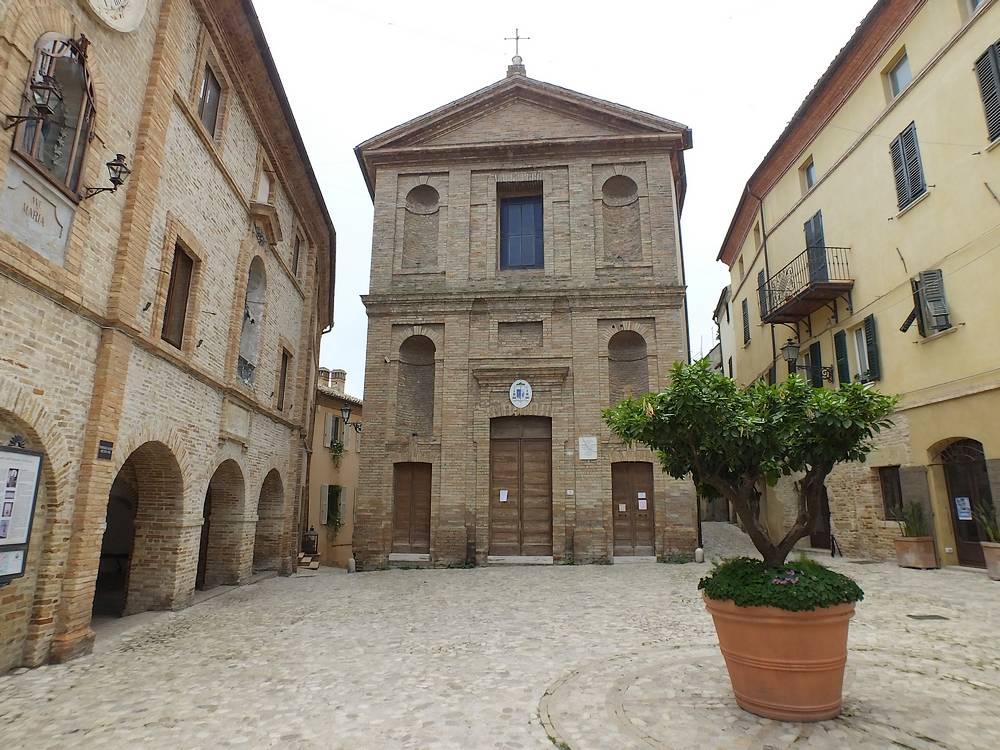
Opened in 2002, this museum – which forms part of the Piceno Sistine Museums network – is housed in the parish church of San Giovanni Battista, situated in the heart of the old town. The medieval building, rebuilt by the architect Pietro Maggi between 1792 and 1809, was decorated in 1911 by the San Benedetto-born painter Giuseppe Pauri, who left a marvellous example of his prolific decorative talent on the vault. The chancel houses a Madonna of Mount Carmel attributed to Ubaldo Ricci (18th century) and the surviving panels of a polyptych by Vittore Crivelli (15th century), as well as a portrait of Sixtus V and a splendid painted wooden church pew, an 18th-century work from the Marche region.
Also on display are an altarpiece by Vincenzo Pagani depicting a Sacred Conversation (c. 1530–1535), a small panel by Pauri depicting the Procession of the Dead Christ in Grottammare, an Education of the Virgin by Filippo Ricci (18th century) and a bust of Saint Lucy attributed to Denis Plouvier, a sculptor associated with Bernini. On the rear façade, adorned with exuberant wooden sculptures carved in the 17th century, stands the marvellous organ, which often accompanies concerts of sacred music.
Finally, the chalice used for liturgical celebrations, which Sixtus V bequeathed to his hometown, is unique in terms of both beauty and history. This is the most important work in the collection, housed in a display case at the far end of the nave. As it bears the inscription ‘F.FELIX PERETTVS DE M.A.EP.S.AGAT.’, we can deduce that it is an object dating from the years when the prelate held the episcopal office at Sant’Agata de’Goti (Benevento). There are many references to this type of goblet, characterised by the elongated knot that first appeared in the second half of the 16th century. Next to it is a commemorative medal from the Church of Santa Lucia (1590), which Camilla Peretti, the Pope’s sister, had erected in Grottammare on the site where her brother was born. This rare object, a late work by the Florentine medallist Domenico Poggini (1520–1590), bears an effigy of Camilla on the obverse and a view of the church in its original form on the reverse.