

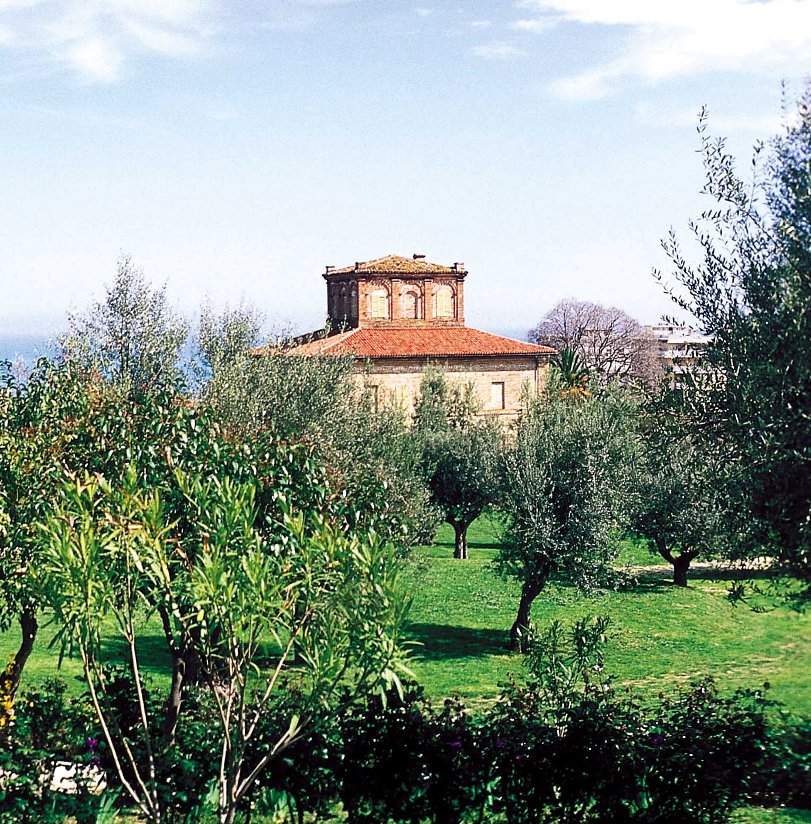
The building dates from around the mid-17th century, a period during which Decio Azzolino (1623–1689) was created a cardinal by Pope Innocent X. A man of many talents and a prominent figure in the Roman Curia, this prelate, originally from Fermo, is known for his close ties with Christina of Sweden, an unusual sovereign who converted from Lutheranism to Catholicism, emigrated to Rome and, together with Azzolino, built up a phenomenal art collection.
The cardinal’s contribution – having inherited the collection upon Cristina’s death (though he himself died shortly afterwards) – was facilitated by his close ties to the Roman artistic circle, in particular to Gian Lorenzo Bernini. The design for the villa in Grottammare is believed to have originated within Bernini’s circle: the names mentioned include Mattia de’ Rossi, his pupil and collaborator, and Luigi Bernini, Gian Lorenzo’s brother.
The building is constructed of brick and consists of a three-storey rectangular block, from which rises a square-plan roof terrace with a loggia featuring round-arched openings, now enclosed by windows. The entrance was originally on the eastern side – opposite the current one – and was accessed via an avenue connected to Via Lauretana (now the Strada Statale).
Refinement, charm and prudence are some of the defining characteristics of this place: the literary pursuits to which the host and his guests (who called themselves the ‘Arcadians of Tesino’) devoted themselves must have been refined, as were the furnishings and works of art within the villa; the gardens surrounding it were delightful, rich in springs, grottoes, statues, citrus groves, fish ponds, fountains and shaded paths, which could even be travelled by carriage; the secret passage, to be used in the event of pirate attacks, which led both towards the beach and up the hill, was a prudent feature, as were the embrasures fitted for arquebuses in the event of a siege.
Whilst all that remains of this is the memory, the building’s massive structure is still intact, a rare example of a 17th-century suburban villa in the area. The building, which passed into the ownership of the local diocese following the death of the last heirs, housed a convent in the second half of the 20th century and subsequently a foundling home. It has long been awaiting restoration.